Chapter1
It’s hard to say whether I did the right thing by going on that business trip. If I hadn’t gone, I wouldn’t have all these problems and would be living a quiet life. But whether that would have been better, I doubt it. I think not; read on and judge for yourselves.
First, a few words about myself. My name is Anatolii, I’m a programmer, I love my profession and I believe programming is as exciting a creative process as any other: a masterfully written program gives no less aesthetic pleasure than a perfectly shaped building or sculpture, and it’s a real pity that only a rather narrow circle of people in the field can admire this creation of the human mind.
I started writing programs back at school, worked in various places as a student, and when I got my degree I was hired by the Kyiv office of International Software Corporation Ltd. I felt at home straight away; the guys on the team were sharp and ambitious, each dreamed of world fame and gave the work everything, so success, financial success included, came quickly, and above all our company is known and respected, and clients are happy to order software from us.
My first year at work flew by unnoticed; my holiday was approaching and I was already dreaming of the shore of the blue sea, where I was going with Nina, my beloved fiancée, when suddenly Yaroslav, the director, calls me in and orders: next Sunday you fly to London for a two-week conference on artificial intelligence; don’t forget to bring your passport, the visa will be ready the day after tomorrow, and Zoriana, his assistant and future wife, will take care of the tickets.
That’s Yaroslav for you. He doesn’t ask whether you can or not: if it’s needed, it’s needed, do as you’re told. But I was glad, because a trip to Britain at the company’s expense is awesome! Never mind that the seaside is postponed, we’ll make up for it!
I spent the time before the flight searching for information on artificial intelligence. I suspect, by the way, that the research institute run by my father, Opanasenko Yurii Petrovych, also works on artificial intelligence, but everything there is terribly classified, and if it weren’t for Dad’s friends I wouldn’t know anything about that institute, or about some important but secret development for which Dad was awarded the State Prize and the rank of general.
My folks were not at all happy about the trip abroad, especially Mum: she still thinks of me as an irresponsible teenager, and if I got married she would hand me over to my wife and breathe a sigh of relief, because women are much more serious than men simply because they are women. I myself was eager to marry Nina, the most beautiful girl in the world, but we had agreed to do it in a year, when she finished university.
Although my parents were against the trip, work is work, and they had to accept it. And Nina, seeing me off at the airport, cried so bitterly, as if we were parting not for two weeks but for ever, and that made me uneasy too...
Chapter2
At Heathrow I was met by a representative of the conference organising committee, Susan, a slim, graceful and beautiful Latin American woman. She took me to the hotel, left me a map for getting around the city and advised me to rent a car.
The conference began in the morning; the talks were interesting, but sometimes I had to strain to understand anything, and not because I don’t know English — on the contrary, I speak it decently — but because everyone mangles it however they please.
In the afternoon Susan helped me rent a car, and I drove back to the hotel. I had just parked in a free space in the underground garage when a black Mercedes tore into the car park, stopped nearby, and two men and a woman jumped out. The strangers seemed suspicious to me, I don’t even know why; maybe because they looked too elegant in that dirty garage next to me, tired, in a sweat-soaked T-shirt, dazed after driving a car with the unfamiliar right-hand steering. I draw your attention to this on purpose, because this is where it all began. In short, I felt ashamed, hunched up and did my best to go unnoticed, and I succeeded: the ladies and gentlemen didn’t even glance my way, slammed the doors and hurried towards the lifts.
Good thing they didn’t notice me, I thought, but a moment later I was seized by a sudden, exaggerated pride. What is this, the thought wouldn’t leave me alone, where does this inferiority come from, how are these three better than me? So they’re dressed elegantly, so what? Overcoming my misplaced shyness, I grabbed my bag and ran after the strangers, and as I reached them I noticed in passing, and was surprised, that one of the men was pressing the buttons one after another, as if he had in front of him not a lift panel but a safe with a combination lock; but I paid no attention, because I was busy with something else: getting there in time, so I wouldn’t have to wait for the next lift. That can’t be explained either, because there was no need to hurry, but evidently providence had stepped into my fate and events could not have unfolded otherwise. In short, I made it, jumped in, thanked those present and apologised, I don’t even know what for.
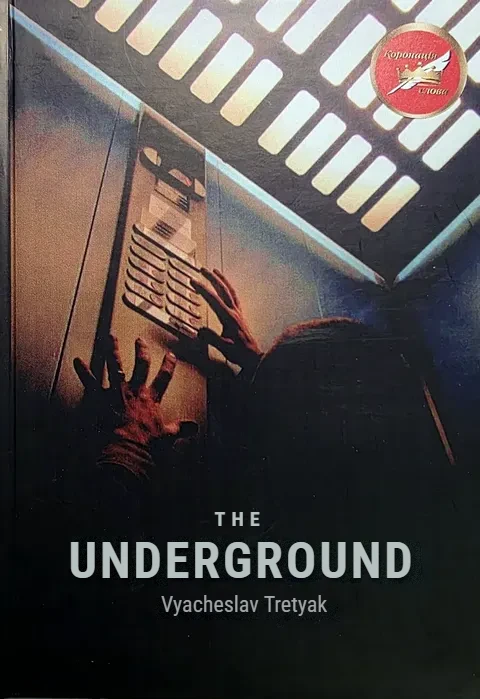
The doors closed, something rumbled beneath the lift and it moved off, but not up — down. I took this calmly, I was even curious where these people were going, but when the number “-2” appeared on the screen I grew anxious, because I distinctly felt the atmosphere suddenly turn hostile: the strangers kept away from me as if afraid of catching some dangerous disease, and at that very moment one of them, apparently the senior one, hit the “Stop” button and the lift halted. In complete silence this man went up to the microphone, pressed the call button, waited for an answer and said in broken English:
“Sanchez here. We have an outsider with us. Potential eighty, maybe more.”
Something clicked in the speaker, and then we heard:
“Are you sure?”
Before answering, Sanchez looked back at his companions, read confirmation in their eyes and said:
“Yes. Very strong.”
For a while nothing happened, until at last we heard:
“Go down to level five, you’ll be met.”
The lift moved off, and I felt trapped. Obviously they were talking about me: I was the outsider, and with something expressed by the number eighty, which was quite a lot on whatever scale of theirs.
On minus five the doors opened into a small room, and I was pushed out of the lift gently but firmly towards three armed guards. My heart leapt in my chest. What the hell, where on earth have I landed?!
One of the men searched me, limp and frightened as I was, took my bag, wallet and keys, examined them, put them in a plastic bag and handed it to the one in the middle.
“Follow me,” said the one in the middle, and headed for the left-hand door, while the other two walked behind, keeping me at gunpoint.
We went along a corridor, turned left and stopped in front of an armoured door. The man stood still for a moment, evidently to be recognised, the lock clicked, and we found ourselves in a small, brightly lit room.
We were met by a stocky, balding man of about fifty, dressed simply yet elegantly all in black.
“You may go,” he ordered the escort, and when the latter, leaving my things on a chair by the door, went out, he invited me to sit at the table and sat down opposite.
For a while we studied each other in silence; finally the man asked:
“Who are you?”
“I’m Anatole.”
“Show me your documents.”
“They’re...” I turned on my chair, wanting to explain that all my things were in that bag over there, but the man stopped me.
“I’ll do it,” he said, got up, took out the wallet and the bag, studied my papers for a while and then spoke in perfect Ukrainian:
“Anatolii Opanasenko, born in such-and-such a year, citizen of Ukraine, on a business trip to attend a conference.”
“All correct,” I confirmed. “Congratulations, your Ukrainian is flawless.”
“I’m Ukrainian, my name is Mykola Nazarovych.”
“Pleased to meet you,” I said, but the courtesy was not returned.
Mykola Nazarovych became thoughtful, and meanwhile I looked around. A table with a computer and an antediluvian telephone, a few chairs, a cupboard, a safe door in the wall, and that was all. I listened to my feelings and was surprised: I wasn’t scared; the man somehow inspired trust. Perhaps because of his calm, or perhaps because he was a fellow countryman, although under the circumstances it was probably pointless to hope for special treatment.
“Mr Anatolii,” the man said at last, “tell me what brought you here.”
“Nothing brought me here,” I honestly admitted. “I was going up to my room, and suddenly the lift went the other way, and here I am...”
“And how did you end up in that lift in the first place?”
“What do you mean, ‘end up’... Very simply! I ran in, that’s all. Those three were already there.”
“Hmm... Now that, in more detail, please.”
“How much more detail? I ran and ran in. Stood and stayed there. Then the lift moved...”
“Did the people in the lift deliberately wait for you to get there?”
“No! They got in, the one who later spoke to you started pressing the buttons one after another, as if he was entering some kind of code... yes, it was odd... and I was running and thinking, I hope I make it, I hope I make it... and I made it...”
“I see,” said Mykola Nazarovych, and sank into thought again. Of course he sees; what is there not to see?
“Mr Anatolii,” Mr Mykola spoke at last, “tell me, have you ever noticed that certain events happen exactly the way you want them to?”
“What do you mean?” I was surprised. “Ah... I get it. Well, yes, sometimes it seemed so, why not? Like everyone. Something turns out the way you want, so you remember it. You draw the exam question you’ve learned, say, or win the lottery, and it seems it happened because you wanted it so much. But such cases are explained by simple probability; you know, there’s a whole science for it: probability theory.”
“I know. So let me put the question more precisely: have there been situations in your life when an almost impossible event happened precisely because you desperately wanted it?”
“No, nothing like that! Although... yes, there was something like it! Long ago, I was still at school: we were set the proof of a difficult theorem to learn; I spent the whole evening on it and learned it; the teacher called up two pupils and not me, and I wanted so much for her to call me, and I knew she wouldn’t, because she always called up only two; but she thought for a moment, called me up and gave me top marks! So I decided she had called me because I wanted it so much, but in fact I don’t know why she called me. Childish fantasies... Later, though, she went back to calling up only two at a time, never three. That’s why I remembered the incident for a long time, then forgot it, and if you hadn’t asked in that particular way, I wouldn’t even have recalled it...”
“I see,” Mykola Nazarovych said thoughtfully, having listened to my long and muddled explanation, while I tried to guess why he was asking such strange questions. Clearly he is wondering how I managed to get into this secret facility. The facility is definitely secret, otherwise why would it be underground? I had no right to be here, and Mykola Nazarovych was probably deciding how to get rid of me — look at the way he interrogates me and stares suspiciously, he probably thinks I’m a spy.
And yet it seemed to me that the man opposite didn’t want to get rid of me. He hesitates. And I’ll help him: I’ll want with all my might for him not to get rid of me but to let me go, like that time with the theorem, because it looks very much as if Mr Mykola is convinced it was my wish that made the teacher call me up! Well, let him think so, it suits me.
At last Mykola Nazarovych made up his mind, picked up the receiver of that old-style telephone, turned the dial twice and said:
“Mr Stanford, come to my office.”
A minute later a very thin man of about forty appeared in the office, in a white coat and gold-rimmed glasses.
“Mr Stanford,” said Mr Mykola, “please run test number two on this young man.”
I followed Stanford, and again we were accompanied by those three.
The test wasn’t complicated. They put a helmet on my head, sat me in front of a computer and explained that I had to drive a car along a winding mountain road, as in a video game. Only I had to steer not with a joystick, keyboard or mouse, but with my imagination. It was strange and unusual; at first nothing worked, the car wouldn’t obey, I couldn’t even get it moving, and when I finally did, it went straight over the cliff, and again and again; but Stanford adjusted something, tuned it, and things went better: I managed to take the bends, brake where needed, and the speed gradually rose, and only when it became truly insane did the car fly off the road, and I felt completely drained, as if after a real race.
A fun simulator, I thought, but the principle must be simple. The helmet reads brain signals, and a special program decodes them and controls the computer. Technically it’s simple, but I was surprised, because I had no idea computers had already learned to read minds.
When we returned to Mykola Nazarovych’s office, Stanford put a printout of the test results on his desk. Mykola glanced at it and grunted. They exchanged looks and nodded: evidently pleased with how well I had driven.
“Listen, Anatolii,” said Mykola when we were alone. “Do you realise that you have got yourself into a very unpleasant situation, and that it is entirely your fault?”
“Well, I never!” I was indignant. “My fault? You think I did it on purpose...”
“I accept that you did it unintentionally, but that doesn’t make it any easier. If you hadn’t made the lift mechanism trigger with a certain delay, which let you get inside where you had no right to be, and before that hadn’t made our staff fail to notice you, nothing would have happened.”
“What?!” I was outraged. “What lift?! What influence?! What nonsense is this?!”
“It’s true!” Mykola Nazarovych said firmly. “All three have just handed me written statements. They didn’t see you because you forbade them to see you, and the delay in the lift doors was undoubtedly caused by your influence.”
I was at a loss. It all sounded very alarming. They were accusing me of something I hadn’t done! But why?! Do they want to blackmail me? They’ve staged some idiotic show with guards and a lab, and now they’ll demand money. And judging by the expensive props, it’s not the first time. The lift, the guards with dummy rifles, a bunch of actors... It meant only one thing: the ransom would be hefty.
“Are you joking, Mykola Nazarovych?” I mumbled, frantically trying to think of a way out of this situation.
“Not at all,” Mr Mykola said seriously. “You don’t think we staged a show for you, do you?”
“That’s exactly what I think! A set-up and nothing more! Do you really hope to convince me that I influenced the lift mechanism? Or made someone not notice me! That’s just ridiculous!”
“I have no intention of convincing you,” said Mykola Nazarovych. “If you don’t believe it, fine. In fact it’s better that you don’t. Better for you.”
I knew perfectly well what was better for me! What would be better for me was to be back in my room and forget this whole stupid adventure like a bad dream, but unfortunately the man opposite was all too real. I fidgeted on my chair, and Mykola Nazarovych glanced at me and sank into thoughts that lasted several endless minutes.
“Listen, Anatolii,” he went on decisively, having evidently made up his mind. “I warn you: no one must know what happened to you. Forget it, put everything you saw and heard here out of your head, otherwise the consequences could be very unpleasant for you. And remember: you will be watched, so please don’t do anything stupid.”
I understood what he was hinting at. If I start talking, they’ll quietly bump me off, and no one will ever know where my grave is. So I nodded vigorously in agreement.
“Read this and sign,” he handed me a sheet of paper with some text.
I had never read any contract as carefully as this one. Although it wasn’t a contract but a non-disclosure undertaking. The gist was simple: if I talk, I’m done for. Having read the document twice, I took the pen and added the date and my signature.
“Now you will be escorted to your room,” said Mykola Nazarovych.
“And my copy?” I asked.
“You don’t need it,” Mr Mykola smiled grimly, “and it could even do you harm,” he added, handed me the bag with my things and saw me to the exit.
“I’m not sure I’m doing the right thing,” he said thoughtfully as we went, “something is prompting me to make an exception to the rules. I’m afraid it’s you who is influencing me like this, Mr Anatolii.”
Again those three took me to the lift, where they handed me over to a woman; we went up with her to the fourteenth floor, and at last I was back in my room. The clock showed 22:15, so this whole nightmare had lasted three and a half hours.
To be continued…